
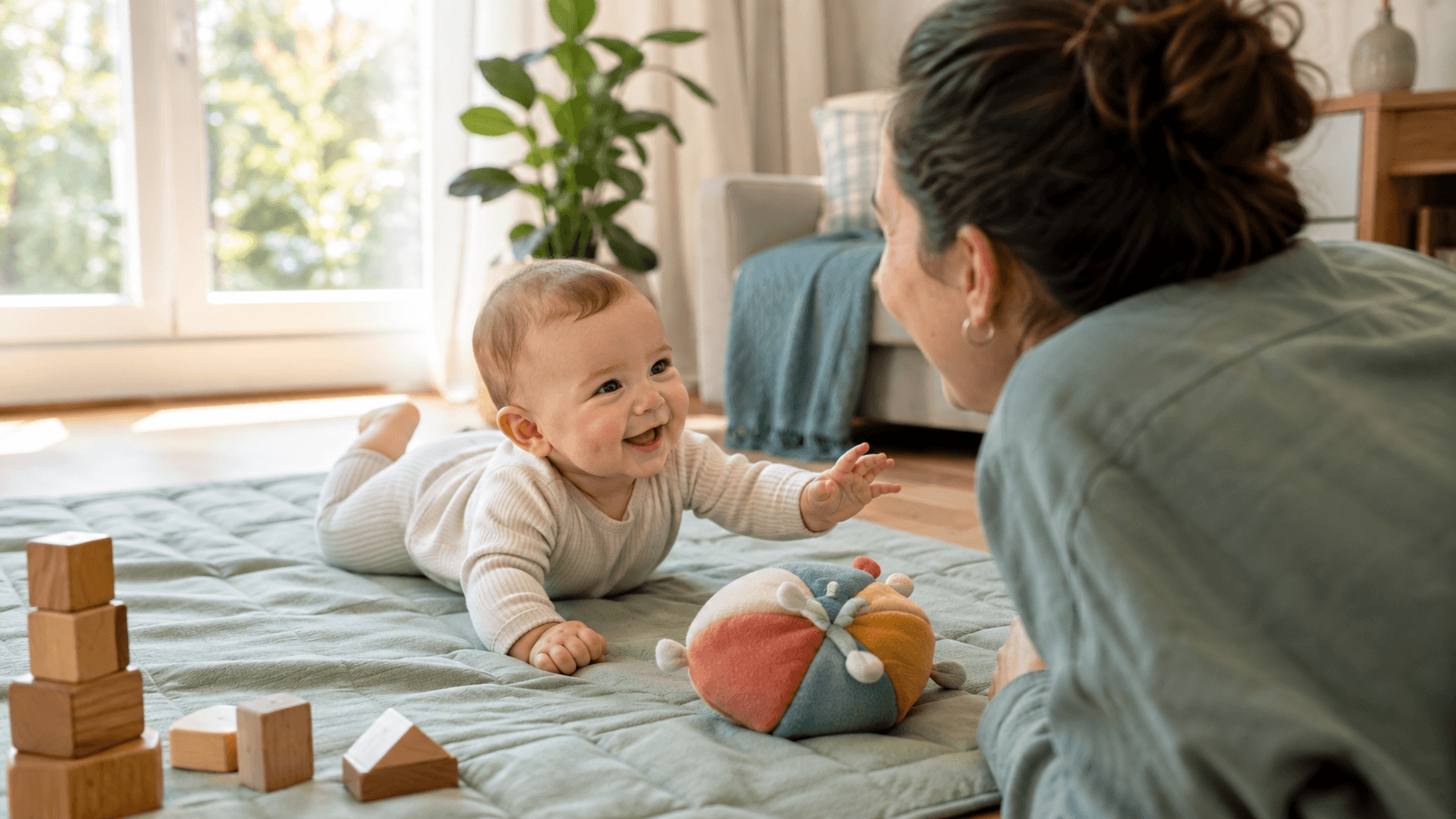

Yesterday, 19 October, was World Paediatric Bone & Joint Day: a global reminder that healthy bones, joints and muscles start in childhood. It’s also a lovely excuse to celebrate something we often take for granted. In just a few years, babies go from curled-up newborns to rolling, crawling, climbing and running little people.
Every roll, wobble and tumble is the brain and body learning to work together. Here’s how that happens, what’s typical, and some simple ways to support your child along the way.
Movement starts before birth
Babies begin moving long before they’re born. These early movements are produced by the developing nervous system itself. After birth, a newborn’s spontaneous “general movements” (small writhing movements at first, then lively “fidgety” movements from around two months) are so closely linked to brain development that health professionals use them to check how a baby’s nervous system is maturing.1
At the same time, the brain is busy wiring itself up. Research on early brain development suggests that sensory input from the body, such as touch, movement and feedback from muscles and joints, helps shape the connections between body and brain during early sensitive periods.2 Put simply: moving helps the brain develop, and a developing brain makes more complex movement possible.
The building blocks of movement
Motor skills build on one another. Developmental kinesiology describes a predictable sequence: lifting the head on the tummy, propping on elbows and reaching, rolling, sitting, crawling, then pulling up to stand. Each stage builds the stability and control needed for the next.3
Just as important, there’s a wide range of “normal”. A World Health Organization study that followed healthy children in five countries found these windows for six key milestones:4
| Milestone | Typical window (healthy children) |
| Sitting without support | about 4 to 9 months |
| Standing with help | about 5 to 11 months |
| Crawling on hands and knees | about 5 to 13½ months |
| Walking with help | about 6 to 14 months |
| Standing alone | about 7 to 17 months |
| Walking alone | about 8 to 18 months |
In the same study, about 4% of children skipped crawling on hands and knees altogether.4 Milestones are ranges, not deadlines. What matters most is that your child keeps progressing, and uses both sides of their body.
After those first steps, the learning keeps going. Toddlers refine their balance as they run, climb stairs and kick a ball. Pre-schoolers start hopping, catching and drawing. By school age, children are combining balance, coordination and fine-motor control for sport, play and handwriting. These skills keep developing throughout the primary school years, so movement and posture are worth keeping an eye on long after the baby stage.
Why tummy time matters
Australia’s 24-Hour Movement Guidelines recommend that babies who aren’t yet mobile get at least 30 minutes of tummy time a day, spread out while they’re awake. They also suggest not keeping babies restrained in a pram, car seat or high chair for more than an hour at a time, and no screen time before the age of two.5
Tummy time builds the neck, shoulder and back strength needed for rolling, crawling and sitting. It also gives the back of the head a break from pressure. Flat spots on the head (plagiocephaly) often go hand in hand with a baby favouring one side, and some studies have linked them with differences in early motor development.6 Remember: always back to sleep, tummy to play.
Everyday play that helps
| Simple ideas for every stage Babies: plenty of supervised floor time on the tummy and back; place toys on both sides so they turn and reach each way; vary how you hold and carry them. Crawlers and new walkers: cushions and soft ramps to climb, tunnels, push-along toys, and time barefoot on safe surfaces. Toddlers and pre-schoolers: at least three hours of active play spread through the day, including at least an hour of energetic play for 3–5 year olds:5 running, dancing, ball games and playgrounds. School-age children: balance and ball skills, riding a bike, swimming and climbing, plus fine-motor fun like play-dough, drawing and building blocks. |
When to check in
Every child develops at their own pace, but it’s worth mentioning to a health professional if your child:
- strongly favours one side: always turning their head one way, using one hand far more than the other in the first year, or crawling lopsidedly
- isn’t sitting on their own by around 9 months, or walking by around 18 months4
- seems unusually stiff or unusually floppy
- trips or falls much more than other children, or finds handwriting and ball skills very hard at school
| See your GP promptly if your child: loses a skill they could previously do, or if you have any concerns about their development. Your GP or child health nurse is a great first step and can refer you to a paediatrician, physiotherapist or occupational therapist if needed. |
How Attune can help
Dr Kaushal Bhuta holds a Master’s degree in chiropractic paediatrics and has more than 30 years of clinical experience, with a particular interest in how movement, posture and sleep develop together.
At Attune Chiropractic in Norwest, our movement assessment is tailored to your child’s age and stage. For babies, we look at how they move and turn on both sides, and at any tension through the neck, back or hips. For older children, we look at posture, balance and coordination.
Where appropriate, we use gentle hands-on techniques to ease areas of restriction, alongside simple home exercises and play ideas so progress continues between visits. We’re glad to work with your GP, child health nurse, physiotherapist or occupational therapist as part of your child’s care team.
| Curious about how your child is moving? Book a free call with our team, or start with our Coordination & Movement guide. Book a FREE call → (02) 8551 2727 |
This article is general information only and isn’t a substitute for individual healthcare advice. Dr Kaushal Bhuta is a registered chiropractor (AHPRA).
References
- Einspieler C, Prechtl HFR. Prechtl’s assessment of general movements: a diagnostic tool for the functional assessment of the young nervous system. Ment Retard Dev Disabil Res Rev. 2005;11(1):61–67.
- Kostovic I, Jovanov-Milosevic N. The development of cerebral connections during the first 20–45 weeks’ gestation. Semin Fetal Neonatal Med. 2006;11(6):415–422.
- Kobesova A, Kolar P. Developmental kinesiology: three levels of motor control in the assessment and treatment of the motor system. J Bodyw Mov Ther. 2014;18(1):23–33.
- WHO Multicentre Growth Reference Study Group. WHO Motor Development Study: windows of achievement for six gross motor development milestones. Acta Paediatr Suppl. 2006;450:86–95.
- Australian Government Department of Health. Australian 24-Hour Movement Guidelines for the Early Years (Birth to 5 Years): fact sheet. 2021. https://www.health.gov.au/sites/default/files/documents/2021/05/24-hour-movement-guidelines-birth-to-5-years-fact-sheet.pdf
- Keil BG, Fludder CJ. Chiropractic Evidence-Based Management of Deformational Plagiocephaly. Australian College of Chiropractic Paediatrics; 2017.