

Term 4 is in full swing. Between assessments, end-of-year events, after-school activities and, let’s be honest, plenty of screen time, it’s a busy stretch for school-age kids. If your child has been coming home rubbing their forehead or saying their head hurts, you’re not alone.
Headaches are very common in children. A review of 50 population studies found that more than half of children and teenagers (about 58%) had experienced headaches, and around 8% had migraine.1 Migraine can also mean missed school days.2 In a study of chiropractic visits in Australia and Canada, headache was the most common non-musculoskeletal reason teenagers came in.3
The reassuring news is that most headaches in children aren’t caused by anything serious.4 Here’s what tends to trigger them, what helps, and when to get them checked.
What usually causes headaches in kids?
The two most common types are tension-type headaches, which feel like a dull, tight band around the head, and migraines, which are often throbbing, sometimes one-sided, and can come with nausea, vomiting, dizziness or visual changes.4 Both tend to run in families. Other headaches come with colds, ear or sinus infections, or dehydration.4
Common everyday triggers include not getting enough sleep, stress, skipping meals or drinks, and eye strain.4
Younger children don’t always say “headache”. They may go quiet or pale, want to lie down, rub their head or eyes, or lose interest in food and play. Older children might describe a tight band around the head, a throbbing on one side, or pain at the back of the head and neck.
Screens, posture and sleep: the Term 4 trio
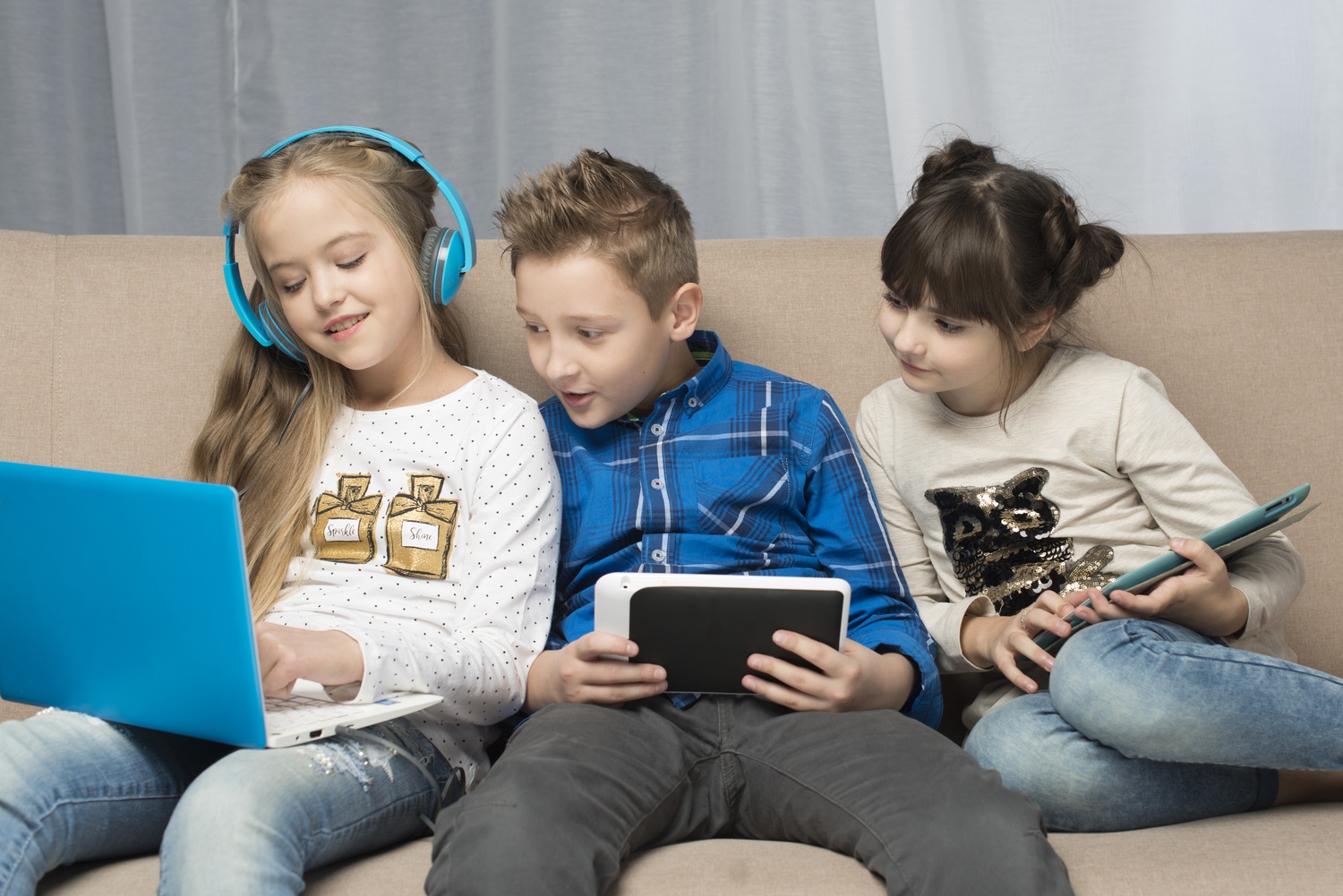
Screens. The Royal Children’s Hospital Melbourne notes that some children get headaches from looking at bright screens, and that holding a poor posture on a device for a long time can also lead to headaches.4 Picture a child hunched over a tablet with their head tipped forward for an hour: the muscles at the back of the neck and upper back are working hard the whole time. Phones held low in the lap, or used while lying down, are often the worst offenders.
Australia’s guidelines recommend no more than two hours of recreational screen time a day for children aged 5–17 (schoolwork doesn’t count).5 In 2023, only about 28% of Australian children in that age group stayed within this limit every day.6
Sleep. Not getting enough sleep is one of the most common headache triggers.4 School-age children need 9–11 hours of uninterrupted sleep a night, and teenagers 8–10 hours.5 Poor sleep also affects concentration and performance at school, particularly in the morning.7 With Halloween falling on Saturday, it’s worth getting bedtimes back on track before the school week starts.
Simple habits that help
| Everyday ways to keep headaches at bay Take screen breaks. Encourage regular breaks and turn the screen brightness down.4 Set up for good posture. Raise devices closer to eye level, sit supported at a desk or table, and avoid long stretches lying on the tummy propped up on elbows. Protect sleep. Keep a consistent bedtime routine, avoid screens before sleep, and keep screens out of the bedroom.5 Check eyesight. If your child squints, gets close to the page or screen, or complains of tired eyes, an eye test is worth booking, as eye strain is a known trigger.4 Fuel up. Regular meals and a water bottle in the school bag help prevent hunger and dehydration headaches. Move every day. Aim for at least 60 minutes of moderate to vigorous activity a day.5 Keep a headache diary. Note when each headache started, how long it lasted, where it hurt, how bad it was (1–10), what helped, what time your child went to bed the night before, and any missed school.4 Patterns often appear quickly. Use pain relief carefully. Follow the packet directions, and don’t use pain medicine on more than two days a week without your GP’s advice, as overuse can cause more headaches.4 |
When to get headaches checked
| See your GP if: headaches are getting worse, or happening more than once a week4 a headache wakes your child from sleep, or is worse in the morning headaches come with vision changes, vomiting or a high fever headaches are disrupting school, home or social life stress seems to be the cause and you need extra support Seek urgent medical care for a sudden, severe headache, a headache after a knock to the head, or a headache with drowsiness, severe vomiting, or problems with balance or speech.4 Trust your instincts: if something doesn’t feel right, get it checked. |
For typical tension-type headaches or migraines, where a child is well between episodes and their examination is normal, scans usually aren’t needed.4,8 Your GP can talk you through what’s appropriate for your child. Encouragingly, identifying and managing triggers usually leads to fewer headaches as children get older.4
How Attune can help
At Attune Chiropractic in Norwest, we see school-age children whose headaches don’t yet have a clear cause. We start with a full history and a gentle assessment of the neck and upper back, along with posture, screen habits and sleep routines.
Where appropriate, we use gentle hands-on techniques to ease areas of tension or restriction that may be contributing, together with practical advice on device set-up, posture and routines. We work alongside your GP and will always refer on if anything needs medical attention. If you’ve been keeping a headache diary, bring it along: it helps us, and your GP, spot patterns in timing, triggers and sleep.
| Is your child getting more headaches this term? Book a free call with our team, or start with our Headaches guide. Book a FREE call → (02) 8551 2727 |
This article is general information only and isn’t a substitute for individual healthcare advice. Dr Kaushal Bhuta is a registered chiropractor (AHPRA).
References
- Abu-Arafeh I, Razak S, Sivaraman B, Graham C. Prevalence of headache and migraine in children and adolescents: a systematic review of population-based studies. Dev Med Child Neurol. 2010;52(12):1088–1097. https://doi.org/10.1111/j.1469-8749.2010.03793.x
- Abu-Arefeh I, Russell G. Prevalence of headache and migraine in schoolchildren. BMJ. 1994;309:765–769.
- Neave M, Swain M, Downie A, de Luca K, Hogg-Johnson S, Mior S, French S. The profile of young people seeking chiropractic care: a secondary analysis of data. Chiropr Man Therap. 2026;34:54. https://doi.org/10.1186/s12998-026-00677-5
- The Royal Children’s Hospital Melbourne. Kids Health Info: Headaches. Updated July 2025. https://www.rch.org.au/kidsinfo/fact_sheets/Headaches_in_children_and_teenagers/
- Australian Government Department of Health. Australian 24-Hour Movement Guidelines for Children and Young People (5 to 17 years): fact sheet. 2021. https://www.health.gov.au/sites/default/files/documents/2021/05/24-hour-movement-guidelines-children-and-young-people-5-to-17-years-fact-sheet.pdf
- Australian Bureau of Statistics. Children’s physical activity, screen time and sleep (2023 data). https://www.abs.gov.au/articles/childrens-physical-activity-screen-time-and-sleep
- Sadeh A, Gruber R, Raviv A. Sleep, neurobehavioral functioning, and behavior problems in school-age children. Child Dev. 2002;73(2):405–417.
- Lewis DW, Ashwal S, Dahl G, et al. Practice parameter: evaluation of children and adolescents with recurrent headaches. Report of the Quality Standards Subcommittee of the American Academy of Neurology and the Practice Committee of the Child Neurology Society. Neurology. 2002;59(4):490–498.